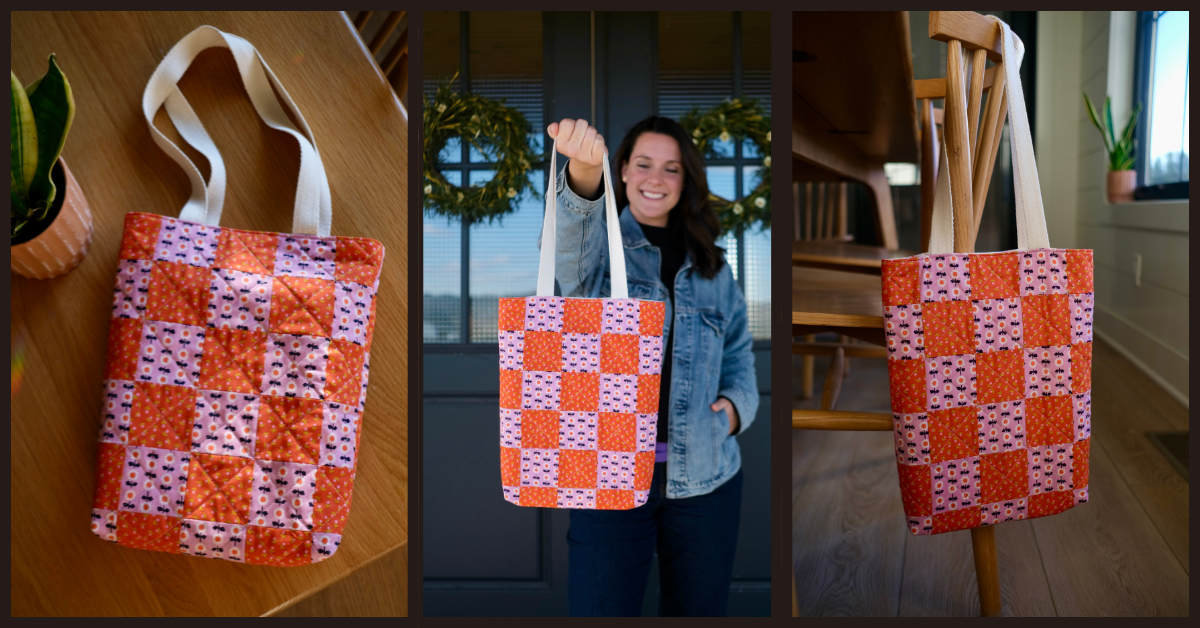
I am so excited to show you how to make this cute, patchwork tote bag! I find myself using tote bags all the time, and this one is such a great size and since it’s quilted it gives some padding and protection to the items inside.
Make this tote bag for yourself, your friends, your family, anyone who needs a tote bag… which is everyone really. This size and design of tote bag is so useful and makes a really great gift!

Patchwork tote bag supplies:
- Outer Fabric: (2) Fat Quarters of fabric or (2) pieces of fabric (quilting cotton) measuring at least 15″ x 18″ (My Fat Quarters that I used for this bag are by Ruby Star Society from Pear Tree Market.)
- Lining Fabric: (2) pieces of fabric (quilting cotton) measuring at least 13″ x 16″ (you can cut these pieces from (1) 1/2 yard pieces of fabric that has a width of fabric of 42″)
- Backing Fabric: *optional* (2) pieces of white or neutral fabric (quilting cotton) measuring at least 15″ x 17″ to use as the backing when quilting the front and back panels of patchwork. (I like to use backing because it gives the bag more shape and I personally find it easier to quilt but you can always skip this and quilt the panels using only the patchwork panel and batting.)
- Batting: (2) pieces of batting measuring at least 15″ x 17″ to be used when quilting the patchwork panels (I like to use 100% cotton)
- Straps: 1″ Heavy Cotton Webbing at least 48″ long (I just keep a roll of this webbing on hand for making bags!) Cut into (2) 24″ pieces.
Basic Sewing Supplies needed:
- sewing machine
- needles/thread for your machine
- pins or clips
- iron and ironing board (I also use a wool mat!)
- ruler (My favorite ruler)
- rotary cutter
- self healing cutting mat
- water soluble marker
- walking foot for your sewing machine
- basting supplies (either spay, glue or pins)
Quilting Terms:
- RST = Right Sides Together (right side of the fabric refers to the side that is to be seen when the project is complete)
- Fat Quarter: a pre-cut size of fabric that is approximately 18″ x 22″ in size
STEPS:
- Cut each of your (2) Fat Quarters of fabric into (5) 3″ x 18″ strips. I start by cutting off the selvage (aka: finished edge of the fabric) and then cutting 3″ strips from there. If the strips are slightly longer than 18″, that is okay. (Photo below is one of my fat quarters cut into (5) 3″ x 18″ pieces)

2. Lay out the strips alternating one strip from one fabric, the other strip from the other fabric, 5 strips total for each of the two side panel units. This is the start of each side of your bag.


3. Sew these strips together using a 1/4″ seam allowance. Press each seam toward the darker fabric. (You will notice that my strips are uneven on one side. FQ can be slightly different sizes. As long as you keep fabric lined up on one side, it will not matter that the other side is uneven.)


3. Cut (6) 3″ strips from each side.


4. Alternate strips from each of the sides to create a pattern.

5. Sew strips together using a 1/4″ seam allowance. Be sure to “nest” the seams of the strips as you sew to keep the pieces aligned. Press seams open.


6. You are now ready to quilt your sides! Make a “quilt sandwich” by placing each of patchwork sides on top of a piece of batting. I also placed mine on top of a white “backing” fabric, but the backing fabric is optional.

7. Baste and quilt each side as desired. I like to pin baste, and using a Kwik clip saves my fingers! On this tote, I quilted lines that ran from corner to corner on each square. Be sure to use your walking foot on your sewing machine for this step.


8. Using a ruler and rotary cutter, trim the batting (and backing) around the quilted fabric.


9. Your quilted sides should measure approximately 13″ x 16″ but slight variations in seam allowance can cause them to be slightly smaller or larger. At this time, trim your lining fabric pieces to be the exact same size as the quilted sides. I laid my quilted sides on top of my lining fabric and used my ruler and rotary cutter to trim the lining.

10. Sew outer sides together. Place the sides RST and pin or clip around the exterior on the 2 longest sides and one shorter side. The un-pinned/clipped side will be the top of the bag.

11. Sew around the pinned/clipped sides using a 1/2″ seam allowance. Be sure to backstitch at the beginning and end.


12. Press seam open.


13. Fold the two bottom corners so that the side and bottom seams line up. Pin and clip in place.


14. On each of the two corners, use a ruler to mark a line from one fold to the other that measures 2 1/2″ long.


15. Sew on that line on each of the two corners. (Be sure that you are still using your walking foot to sew these layers together!)

16. Cut the corner 1/4″ away from the seam/line.

17. Flip the bag right side out. This is how it should look so far. It’s coming together!


18. Time to sew the lining! Place your lining pieces RST. Mark two lines 6″ apart on the bottom side of one of the pieces. Pin lining pieces together on the longer sides and bottom corners.


19. Sew using a 1/2″ seam allowance along each of the longer sides and bottom corners stopping at the mark you made on the bottom side. The opening you leave at the bottom is very important! This is the opening you will use to turn your bag right side out after sewing it all together.
Press seams open.

20. Next we will fold, pin, and sew the corners of the lining just like we did on the outer part of the bag. Fold each of the two sewn corners together and match the seams. Pin or clip in place.

21. On each of the two corners, mark a line on the corner from fold to fold that is 2 1/2″ long.


22. Sew on the line. Be sure to back stitch at the beginning and the end.

23. Cut the corner 1/4′ inch away from the seam. Your lining should look like this:

24. Place the straps: Take one of the 24″ pieces of 1″ cotton webbing and place the ends where you would like the straps to be on the outer bag. Clip in place. Repeat on the other side.


25. Slip the outer bag inside of the lining. Make sure that these pieces are RST. You will only see the “wrong” side of the lining. Clip the top raw edges together. Start at the seams by lining them up and clipping them, as shown below. I use lots of clips all the way around to keep these pieces in place!


26. Sew around the top edge using a 1/2″ seam allowance. Back stitch at the beginning and end. I also back stitch on the handles to make the seam even stronger where weight will be carried. (Take your time! You are sewing a lot of layers together. My walking foot is still on and I took off the larger tray on my sewing machine so that the bag could slip around the machine.)


27. Turn the bag right side out: (My favorite step!) Pull the outer part of the bag through the bottom opening in the lining.


28. You will now need to close the hole that you left in the opening. I like to hand stitch this closed on the fold that was made when pressing the lining seams open.


29. Push the lining into the bag. Press the top seam.

30. Sew around the top as close to the edge as you can get, about 1/8″ seam allowance.

YOU DID IT! You now have a beautiful, patchwork tote bag! I hope you enjoyed this tutorial. I would love to see your bag! Tag me on Instagram @inthelightquilts

Leave a Reply